
BASIL June 2026
- Version
- Download 121
- File Size 5.45 MB
- File Count 1
- Create Date 1 June 2026
- Last Updated 1 June 2026
BASIL June 2026
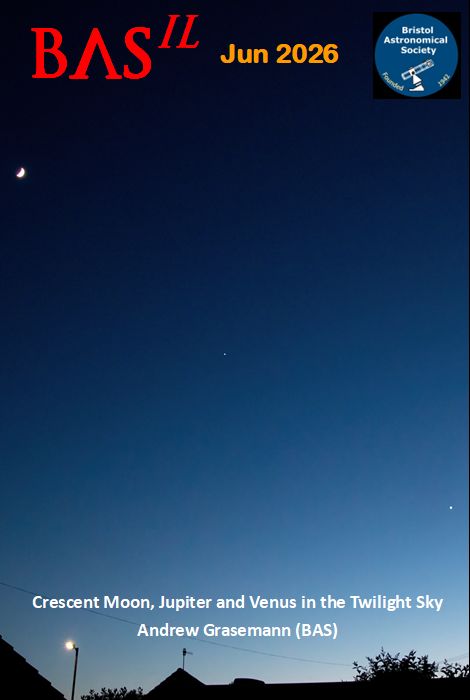
The front cover shows an image of the crescent Moon, Jupiter and Venus all in a line in the twilight sky, recently taken by BAS member Andrew Grasemann.
Monthly observing opportunities
- All month: Noctilucent cloud season.
- 9 June: Venus lies 1.6° north of Jupiter.
- 15 June: Mercury is at greatest eastern elongation (evening).
- 17 June: Bright Venus lies 0.7° north of the waxing crescent Moon.
- 29 June: Tonight's low full Moon is a micro-moon.
- Observe the 'Strawberry Moon' and the Vallis Alpes - best observed around the First Quarter ( 7 to 8 days old Moon).
- 18 DSO observing targets are listed for the month.
- Constellation of the month is Corona Borealis.
Members' images this month
- Makarian's Chain by Andrew Grasemann.
- M106, M100 and NGC 4321 by Chris Lee.
- Lunar X and V by Andrew Grasemann.
Observing project for members: imaging Corona Borealis and the Blaze Star
- A star system 3,000 lightyears away known as the 'Blaze Star' is set to be come visible to the naked eye, shining like a 'new star' in the sky.
- T Coronae Borealis, also known as T CrB or the 'Blaze Star', last brightened in 1946, and astronomers initially predicted it would brighten again by September 2024.
- As of mid-2026, T Coronae Borealis, the Blaze Star, hasn't exploded yet, but when it does happen, its apparent brightness will temporarily increase.
- If you start photographing Corona Borealis now, you'll be able to track changes in the constellation over time, and may even capture the moment the Blaze Star brightens.
- See p29 for more information on how to image Corona Borealis.
The BAS programme of meetings for 2026 can be found on p30.
BASIL June 2026